Read and React Offense Di Rick Torbett
Notes on the Read and React Offense
By Dr. James Gels, from the Coach'south Clipboard Basketball Playbook
Disclosure: This page contains affiliate links, which ways that Motorbus'southward Clipboard receives a small commission (at no cost to y'all) if you make a purchase using these links.
Watch this preview and encounter what coaches at all levels are proverb about the Read and React.
The Read and React criminal offense was developed by coach Rick Torbett (BetterBasketball.com). Beneath is a review of this criminal offense, and some of my thoughts almost information technology after having used it for a few years (varsity boys). This is by no means complete, merely hopefully gives you an idea of what it's most. See Rick Torbett's Betterbasketball Read and React Offense for the complete package.
Nosotros were formerly a 3-out or 4-out motion offense team, but switched to the Read and React offense a several years ago. Information technology basically is a motion law-breaking, simply with specific rules and "reads" for players without the ball. The player with the brawl is free to do what he/she sees best... drive, shoot, or pass and cut. We get more player movement and less continuing around with this offense. Nosotros can nonetheless call set plays, but if the play fails, nosotros just autumn dorsum into the Read and React as our bones offense - Passenger vehicle Gels
General Points
- Similar to but different from motion offenses. In R&R, thespian with ball ("initiator") has options to exercise multiple things. The other four players ("reactors") read and react to what the guy with the ball does, and there is only one correct off-ball motility.
- Very flexible, can utilise with almost any set - iii-2, 4-1, 5-out, 1-four loftier, etc. Can be used in an up-tempo quick assault offense, and in transition, or in a deliberate, slow offense. You can use it as a delay offense without changing anything - just tell players "lay-ups only".
- Can be used against both man-to-man and zone defenses, so you don't demand a split up zone offense.
- Yous can run plays, just use the R&R rules in one case the play breaks downwardly or fails.
- Is a "arrangement"... taught in 17 layers. Could showtime in 5th form with layers one and two, and add a layer every year equally the kids progress. You can kickoff information technology out with your varsity, teach first few layers and gradually add together the layers as the weeks progress - makes you a better offensive squad by tournament time. Varsity level players can progress through the layers more quickly given their skill level and maturity.
- Makes your defense ameliorate past having to baby-sit the R&R every twenty-four hours in practice.
- Teach this offense past using R&R breakdown drills every practice, and 5-on-5.
Teaching Law-breaking by Layers (17 layers)
First with layer #1 and progress. Each layer must be learned earlier the next is added and becomes a "addiction" (automated without having to call up). Each layer is taught using breakdown drills.
LEVEL A - Laying the Foundation
Layer #1, Dribble-penetration
Other 4 players use "
circle motion" on the perimeter and rotate to fill the spots. The direction of the dribble-drive (right or left) determines the direction of the perimeter rotation. If brawl penetrates correct, the circle rotates right (counterclockwise). If the ball penetrates left, the circumvolve rotates left (clockwise).
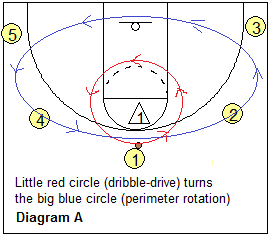
The but exception is distill-penetration along the baseline (meet below) - the contrary corner stays, then that the baseline dribbler has the option of passing to the opposite corner.
Ball options:
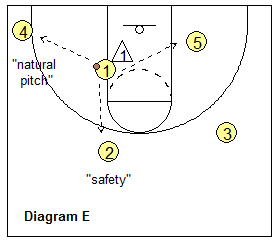
1. Dribble from the top - score, pitch out to corner-wing ("natural pitch") or back out to "safety valve" (back to the spot vacated by the dribbler), or dish within. Ever fill the spot where the penetrator started from, every bit this "safety" spot is often wide open.
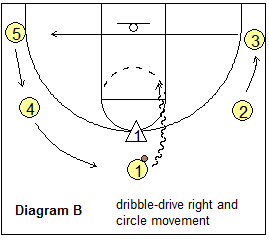
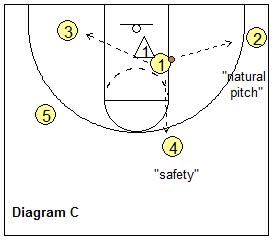
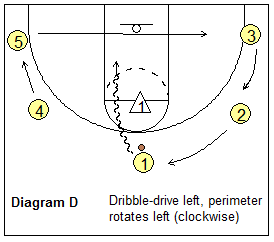
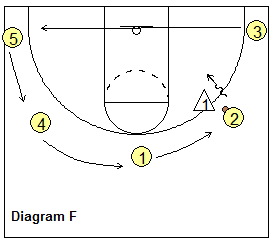
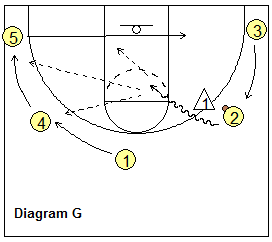
2. Wing dribble penetration - score, pitch out opposite, or dish inside.
Layer #2, Baseline dribble-drive
Nosotros always want the reverse corner filled for a kick-out pass. In our perimeter rotation with baseline dribble-penetration, we desire these spots filled: the "rubber", a "90-degree pitch", and a "45-degree pitch", in improver to filling the contrary corner.
Offense in iv-out (diagram I): Opposite wing moves to corner.
Post rotates up to 45 degree spot.
Contrary fly rotates to ninety degree spot.
Ball-side wing rotates to vacated corner (safety).
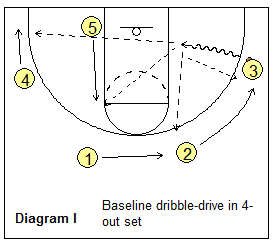
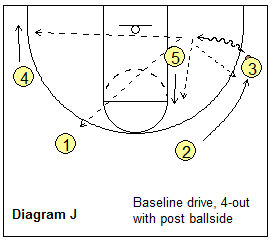
Diagram J shows the rotation when the mail service player is ballside. Hither the mail player I-cuts to the ninety-degree spot, and the opposite top player (O1) stays put at the 45-degree spot, while O2 rotates to the safety spot.
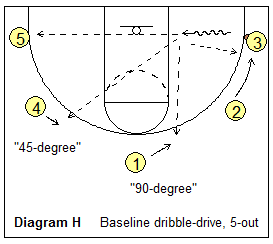
Offense in 5-out (diagram H): Contrary corner stays.
Reverse wing rotates to 45 degree spot.
Point rotates to 90 degree spot.
Ball-side wing rotates to vacated corner (prophylactic).
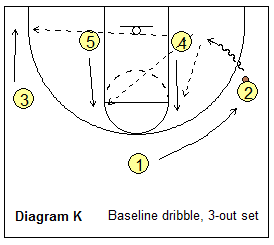
Opposite wing slides downwards to reverse corner.
Both posts rotate up to 45 degree and 90 degree spots.
Point rotates to vacated wing-corner (safety).
Layer #3, Pass & Cut layer
Rules...
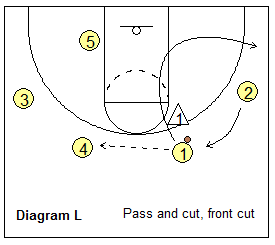
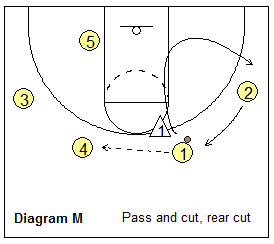
1. Passer: later passing, always handbasket-cutting on a pass 1-spot away. The basket-cutting should go all the way to the hoop before filling out to the perimeter. On a perimeter laissez passer this would be either a forepart cutting (diagram Fifty), or a back-cut if defender overplaying (diagram K). This cut eliminates the hedge defender once the brawl is passed to the next spot. If the pass is made into the mail (also merely one spot abroad), then at that place will exist either a Laker low cut, a Laker high cut, or a slide to the corner, or an "Ten-cut" (see Layer 12 below).
Note that the passer does Non cut on a skip laissez passer (two spots abroad).
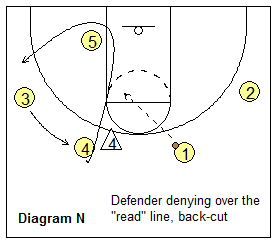
2. Pass receivers: if defender has a foot beyond the 3-point arc (aggressively denying pass), dorsum-cutting (diagram North). We telephone call this "one pes over the read line" => back-cut. The next perimeter player over will naturally rotate into this vacated spot and is usually open.
3. After a cut, open spots are filled from the baseline up, and the basket-cutter fills the open up corner spot.
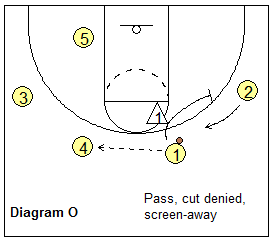
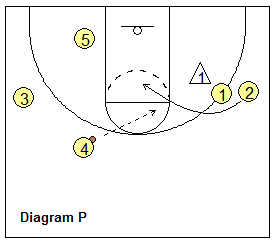
Cutting Options...After passing, a cutter may exist "stood up" by the defender who impedes and prevents his cutting. Instead of fighting the defender, we apply coach Bob Knight's "corner" principle - the cutter simply moves sideways and screens-abroad (diagrams O and P).
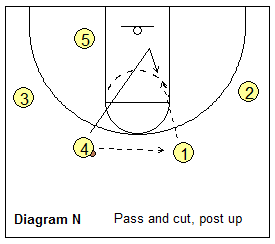
A perimeter thespian may wish to post upwards his defender inside (if he is a natural post player, or if he has a size mis-match, or if his defender is in foul trouble). Diagram N shows O4 passing, cutting inside so "shaping up to the brawl", or posting up.
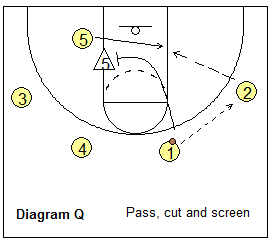
A perimeter histrion may pass and cut and and so screen for a post player inside before filling back out to the perimeter (diagram Q). We also call this "chipping" or "bumping" the post defender. Then "pass and cut" becomes "laissez passer, cut, and screen". A perimeter player could also pass, cut and back-screen for another perimeter player (meet Layer 8 below).
Layer #4, Post-player aligning to dribble-penetration
Rules...
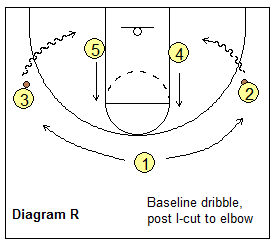
i. If distill comes from baseline, post slides upwards to elbow (diagram R).
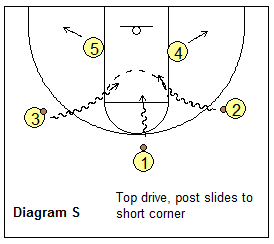
2. If distill comes from the acme, post moves to brusk corner (diagram Due south).
3. Rules 1 and 2 utilise whether mail is ball-side or weak-side.
Layer #five, East-Due west (lateral) dribbles
Iii types of East-West dribbles: speed dribble, power distill, circumvolve opposite distill
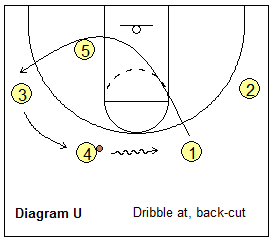
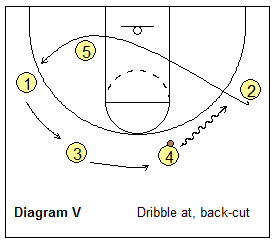
Distill At, Back-cut (Lateral Speed Distill) Dominion...
i. If someone is speed-dribbling at you, dorsum-cut to hoop (diagrams U and Five). Circle movement rules utilize equally earlier.
LEVEL B - Completing the Foundation
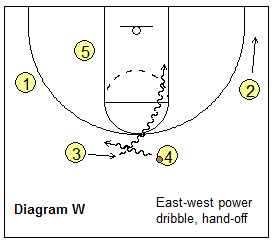
Layer #6, Eastward-West Power (manus-off) dribble
ane. Power distill opinion: dribbler turns back to basket and shuffle dribbles sideways. This has to look different than a lateral speed dribble. Player being dribbled-at V-cuts and and then comes over for paw-off (diagram Westward), and you can run a pick and curl.
2. Uses:
a. A pressure-release move.
b. A way that a mail service player on perimeter tin go rid of brawl, can pick and whorl, and can go into the post. Can create mis-matches.
c. This is a mode from going five-out to 4-out to iii-out. Once post role player cuts inside off the screen, he can either movement out to open spot on the perimeter, or he can stay inside and post upward.
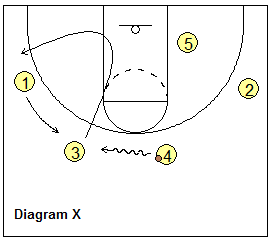
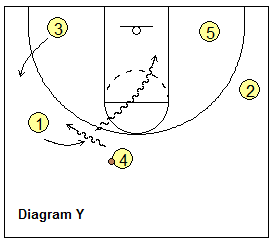
3. If teammate fails to read the power dribble and back-cuts through (diagram X), the dribbler can keep power-dribbling to the adjacent perimeter thespian (diagram Y), or reverse and dribble dorsum to the adjacent teammate.
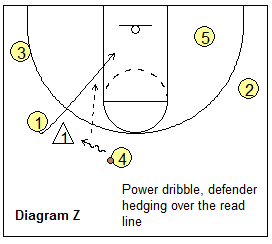
4. If the defender (X1) guarding our "hand-off receiver" (O1 in diagram Z) is over the read line and denying the hand-off, O1 back-cuts for a quick pass inside.
Layer #seven, East-Due west Circumvolve-Reverse Dribble
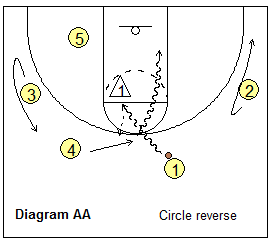
i. This is a response to a failed dribble-penetration. The next player, circles back for a pitch dorsum on the perimeter, and the other players reverse their circle move also. This pitch back is like to that used in the dribble-drive movement crime.
2. The player receiving the pitch-back could shoot the 3, or dribble-bulldoze to the hoop.
See the complete article in the members section. The consummate commodity besides includes:
- Layer #eight, Back-screens
- Layer #9, Multiple Staggered Screens
- Layer #10, Advanced Post Player Reactions
- Layer #11, 4-Out, ane-in Post Blocking
- Layer #12, 4-out, 1-in Mail service Passing - Lakers Cuts, X-Cutting, Corner Slide
- Layer #thirteen, 3-Out, two-in Distill-Penetration Game
- Layer #14, Counter Help-side Defense - Pin and Skip Pass
- Layer #15, Attacking Zone Defenses - the Read and React Zone Offense
- Layer #xvi, Seamless Transition from Fast-break to Half-Courtroom Offense
- Layer #17, Flowing from Fix to Prepare
- And a detailed Animation!
Sentinel this Rick Torbett'southward preview of the Read and React.
Related pages:
- Read and React Offense Breakdown Drills
- 3-Out Read and React Criminal offense
- Notes on the Read and React Zone Offense
Source: https://www.coachesclipboard.net/ReadandReactOffenseNotes.html
0 Response to "Read and React Offense Di Rick Torbett"
Post a Comment