Why Does She Want to See the Bag Boy Again
I stood and looked down into the canyon, at a spot where, millions of years ago, a river cut through. Everything almost that view is incommunicable, a mural that seems to defy both physics and description. It is a identify that magnifies the questions in your mind and keeps the answers to itself.
Visitors ever ask how the canyon was formed. Rangers often give the aforementioned unsatisfying reply: Wind. Water. Time.
It was April 26, 2016 – four years since my female parent died. Four years to the day since she stood in this same spot and looked out at this aforementioned view. I however catch my jiff here, and feel dizzy and need to remind myself to breathe in through my olfactory organ out through my oral cavity, slower, and again. I can say it out loud now: She killed herself. She jumped from the edge of the M Coulee. From the border of the earth.
I went back to the spot considering I wanted to know everything.
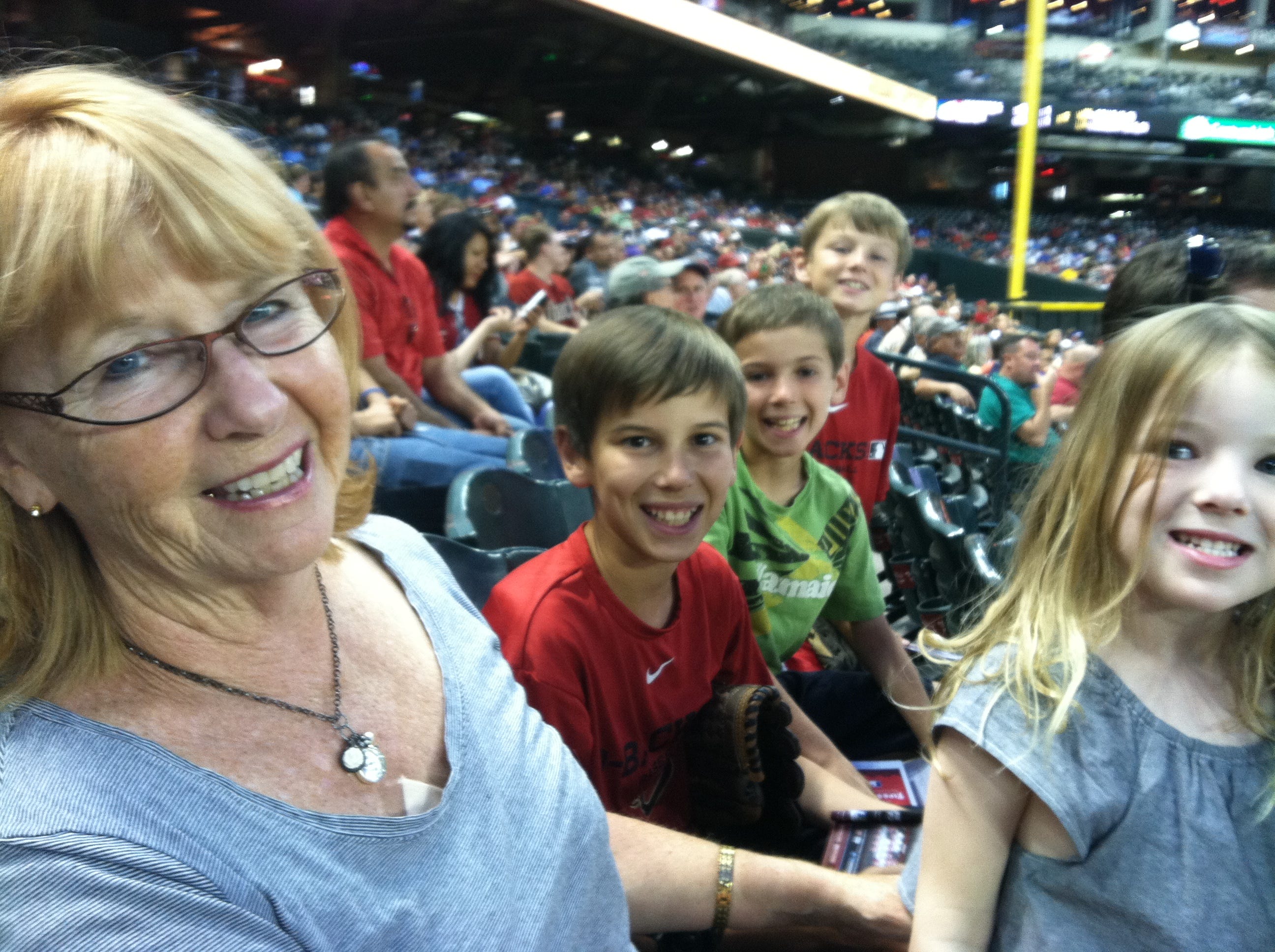
The breadth and longitude where she landed, the terminal words she said to the shuttle bus commuter who dropped her at the trail overlook, her mood when she met with her priest simply four days prior. I read over the last letter she had mailed to my children. I looked for clues inside this trivial carte with a drawing penguin fatigued on the front, written in cake press and so my v-year-former daughter could easily read it. My mom wrote of riding the Low-cal Track to a Diamondbacks game, of planting a cactus garden, of looking frontward to summer in the already hot days of a Phoenix leap.
I read and reread her last words written in cursive in the tiniest composition volume that she had left in her Jeep, besides equally the last text she typed, in which she both celebrates life and apologizes for it. I zoomed in on the photo she took with her iPhone from the ledge looking out to the sunrise that lit the canyon that morning to see if the rocks or shadows would share annihilation new. I replayed our last conversation, and each one earlier information technology that I could retrieve.
I wanted to know every fact, every detail, to meet everything she saw, because I didn't have the ane thing I wanted – the why.
I came back to the canyon for answers, or a deeper understanding of life and my female parent, or maybe myself. Simply all I could meet were the peaks miles away, the copse greener and prettier than I imagined, tiny dots of figures moving slowly up the switchbacks, and the stillness of the world.
Suicide is equally mutual and as unknowable as the wind that shaped this stone. Information technology's unspeakable, bewildering, confounding and devastatingly pitiful. Don't endeavour to figure information technology out, I told myself, stop asking questions, assigning arraign, looking.
Yet there I stood, searching.
• • • • • •
The morning time she jumped, she tried to accomplish me.
I saw "Mom" popular up on my phone soon afterwards 10 a.m. I was sitting at my desk on the 19th floor of the Cincinnati Enquirer edifice at a new job as the managing editor I hadn't quite settled into nonetheless, just ane photo of my children on my desk.
I quickly texted: "I love you mom. Crazy busy work day. Hard to break away to talk. But know I honey you."
On my brusk drive dwelling house that night, I smiled when I noticed the iris were starting to blossom in our neighborhood. I stopped the machine, hopped out and took a photo of an iris to text to my mom later. It was our favorite bloom – hers because of the tenacity they need to abound in the rocky mountainside where she lived, and mine because when I was a kid, they bloomed for my birthday.
I might take more after my dad; I have his olive skin and eyes that are and so chocolate-brown they are near black, his expect of serenity disdain when I am angry and his need for popcorn at the movies. But I was closer to my mom.
We lived iii.iii miles from each other for most of my adult life. Sometimes she would cease past to see my kids, and we would rub each other's manus while we talked well-nigh the mean solar day. When I moved to Ohio recently, we talked on the phone every day.
Nosotros could make each other express joy, and sometimes information technology seemed any she felt, I did, likewise.
That night, my husband said he needed to talk to me. "Come upstairs, and permit's sit down."
I put a lasagna in the oven and walked upstairs and sat on our bed.
We'd been fighting. We had moved from my hometown of Phoenix to Cincinnati iii months earlier, and it had been a rough transition – a new city where we had no family unit, iv kids in new schools, a house where the rent was too high and we seemed to be saying also often, "Can you wait until next Friday?"
He looked serious.
"Information technology's your mom," John said.
And somehow I knew. He read my face.
"Yep," he said. "She'southward gone. She was at the Grand Canyon. … They plant her torso in the canyon."
He used the word body.
I couldn't remember, couldn't process order or fourth dimension, and I took John's T-shirts out of a drawer to re-fold them.
"Nosotros need to tell the kids," I said.
I started to cry in a way I wasn't sure I would e'er stop, in a way that I was no longer enlightened that this might scare the children.
Henry and Theo would empathize this. They were 13 and eleven, smart and mature. Just Luke was just 9 and wouldn't even talk about the move. And Lucy was 5 and missing her grandma then much that every night she looked at a photo volume my mother had recently made for them.
We came downstairs and found them waiting in the dining room, they knew something was upwards. My confront was ruby-red and my eyes wet and swollen, which wasn't new, only part of who their mother had become lately. I sat on the woods floor leaning against the wall, pulling my knees to my chest. Lucy sat closest, and they formed a row adjacent to me forth the wall.
There was no way effectually this, no style to tell this.
"Grandma died," I said. "I'grand and so distressing."
Luke and Lucy crawled into my lap. Henry looked afraid. Theo asked what happened.
"Her heart stopped working," I said. It was true, information technology did terminate working. Nosotros would tell Henry and Theo the residuum later, in private.
I started to cry in a manner I wasn't certain I would ever stop, in a way that I was no longer aware that this might scare the children. John called my psychologist, and although she worked ix miles away, she happened to exist at a church iv blocks from our business firm. When she got to the house, I told her I was to blame.
"No," she said. "Your female parent made this choice."
The lasagna, I remembered. I yelled to John to take it out of the oven.
"Laura," she said, "this is not your fault, not your doing."
Simply maybe information technology was. The alphabetic character, I idea. I should not accept sent that letter.
Three days before, I had written an email to my mother. It was a letter I had written and deleted and written over again. It talked nigh things that I'd hidden for years, things I was finally trying to make her see. It doesn't affair, I told myself. It doesn't.
She is gone. She's gone because she wanted to be gone. But did I button her?
NEWSLETTER: Personal updates from the writer and more on Surviving Suicide
Counting backward
Looking for answers afterwards my mom'due south suicide
Reporter Laura Trujillo returns to the Grand Canyon, where her female parent died past suicide, and reckons with "the great unknown."
David Wallace, Arizona Republic
A few months before my mom died, in the fall of 2011, I sat in a Phoenix role with a psychologist, the first fourth dimension I'd done 1-on-ane counseling. I don't know what'south making me pitiful, I told her.
We explored work. I loved my job working at my hometown newspaper. We explored family unit. I had a bang-up husband and four wonderful kids.
Then childhood. It was good, I told her. It was expert, the bad couldn't accept away that part. Information technology was good, I said again, until slowly, the truth unraveled. The details came out i at a time, similar from a leaky faucet, steady at first and then faster.
I was 15 when I saw my stepfather naked.
Not because I was looking, but because he wanted me to see.
He came into my room. Not because he needed to.
He told me not to say anything.
And I knew I wouldn't. My mom was happy for what seemed to be the start time in her life. I couldn't ruin that, I told myself, no matter what he did to me. Shut your eyes, count backward from 10. And again until information technology is over.
Push it to a corner of your encephalon. Shut the box.
For years my stepfather raped me to the indicate that I questioned whether it was my fault. I day it stopped almost as quickly as it began, and I blocked information technology from my listen for decades. I told no ane.
I went to Sun dinner at my mom's house, camped with her and my stepfather in their motor abode in Flagstaff, and took intendance of their xanthous Labrador, Moe, when they went skiing. I pretended information technology never happened until one mean solar day I couldn't.
Later a few appointments with my psychologist, I told my mom one evening in the forepart yard when she had stopped by my firm. That day she didn't say she didn't believe me, merely she didn't seem surprised. She didn't accomplish over to hug me, didn't ask how, didn't say she was distressing. She went home to him.
I struggled to understand how she didn't seem to want to know more, didn't seem aroused with him, didn't seem to practise anything about information technology. I was angry and pitiful in a way neither of u.s. knew how to handle.
We're not supposed to blame ourselves when someone we dear kills herself, but often practice anyway. What if I hadn't moved away? What if I'd kept tranquillity about my stepfather? What if I had answered her phone call that morning?
For a while we ignored the subject area altogether. But slowly her deprival gave fashion, and she started asking questions. She wanted to know how the human she knew, the 1 with the gentle eye who hired a homeless man to work in his bike store, could exist capable of this. Nosotros went days without talking, then talked until we both couldn't breathe from crying.
One night, perchance a month before she died, while she and I talked or mostly cried on the phone near how sorry she was and nigh how much information technology hurt me and how distressing I was and how much I missed her and needed her, she confronted him. I could hear her yelling at him with me on the telephone: Did y'all do this? He kept maxim, "I don't recollect. I don't call up." Maybe he didn't, couldn't. She was aroused, yelling at him: "Why did you do this?"
Her husband was 66 and sick. He drank a lot, and a encephalon tumor and stroke left him dependent on her. My mom and I had been circling each other similar wounded animals, each apologizing to the other, for a few months when I wrote and deleted and rewrote the alphabetic character and finally hit "transport." It didn't tell her anything she didn't know, simply information technology spelled out that he had driveling me for years, how hard it was to have him come up into my room then many nights, and and then there was this: I didn't tell her and so because I wanted her to be happy. I told her I didn't forgive her, because I didn't need to. It wasn't her fault. I told her I loved her and needed her.
Nosotros're non supposed to blame ourselves when someone we love kills herself but oft practice anyway. What if I hadn't moved away? What if I'd kept quiet about my stepfather? What if I had answered her phone telephone call that morning?
The "what if" question held me the tightest at night, keeping me awake until the sunday peeked through the shades.
I needed to know if I was to blame.
My mom was a retired nurse and hospital administrator with a good pension. She had a volume club and friends she hiked with weekly. While she hated that iv of her grandchildren had moved then far away, she had four more who lived shut and plans to visit the others soon. I needed to find out what I had missed. I needed to know, to understand how someone who seemed so happy could be and then sad.
I'd comb through my mother's life, looking for clues. I'd larn that she had been seeing a psychologist and had been prescribed antidepressants. I'd talk to my sister, endeavour to enquire questions of my grandmother and aunt, and I'd drive 966 miles to Florida to spend a week with my mom's best friend from when I was a child.
I'd learn everything I could from doctors who written report suicide notes to psychiatrists who personalize medicine to care for depression. I would learn that suicide is at present the tenth-leading cause of expiry in the U.s., with numbers increasing in nigh every state, and that money for inquiry to meliorate understand information technology remains low. I'd explore the ugliness inside my own family and the ripples of sexual abuse.
EDITOR'Due south Annotation: Why we're sharing this story
SUICIDE PREVENTION: It'south one of the nation's pinnacle killers. Why don't we treat it like one?
The funeral
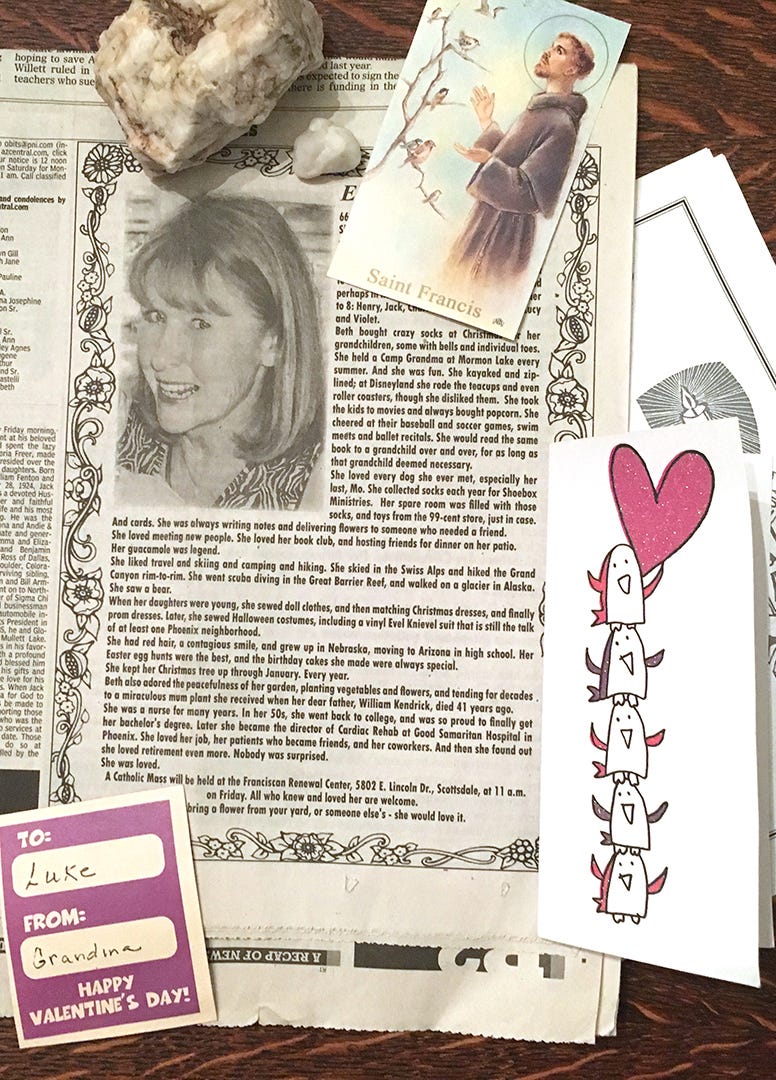
The twenty-four hour period before my mom'southward funeral, the church building was tranquility. It was May and already 100 degrees in Phoenix. I walked past the meditation chapel and through a healing garden and rock labyrinth to detect the priest that my mom had been talking to the past few weeks.
He had a trim white bristles, a bald caput and round wire-rimmed glasses. He couldn't tell me what he had discussed with my mother but that she told him she thought she no longer needed counseling.
I had learned that when some people decide to kill themselves, they seem more at ease than they have in a long fourth dimension, because they know that if they show any suicidal signs or besides much distress, others volition try to talk them out of information technology.
My mom believed in God. I sabbatum down and asked if my mom was OK. I idea he could explicate.
Instead of answering, he told me a story about his own mother who had died and how on an autumn day a few years ago he was lying in a hammock and he saw her again.
He was just a man in a Hawaiian shirt and Birkenstocks telling me a story.
I wanted a new priest. I wanted someone to tell me my mom was OK.
My sis and I had talked and agreed on a few things: I would write the obituary, our mom would be cremated, the service would include a full Mass. We called it a Celebration of Life, as if at that place was such a thing in the moment.
They thought she wasn't strong enough to hear it. And maybe she wasn't.
One of my mom's favorite places was her garden, so we asked that friends bring flowers from their yard or someone else's. Roses and mums, prickly lantana and xanthous branches of the Palo Verde lined the church. Lucy held Fred, a stuffed dog that was recently handed downwardly to her past her biggest brother. Luke held Henry's hand.
I wanted to ask my grandmother what happened, what she knew, the parts of the story she understood, her truth. Non right then, maybe later that week. But when I saw my grandma, she looked at me, my hubby and our 4 children and she waved us off.
She blamed me, I learned later, as did my mom's sis and brother. My mom had told them I had told her about the abuse and she was upset. They thought she wasn't potent plenty to hear it. And maybe she wasn't.
Ten minutes into the service, my stepfather walked in.
At the funeral I told stories of my mother, how she never wanted anyone to be cold, how she would knit caps for her grandchildren when they were babies, even in the summertime, of how she collected socks for the homeless then their feet wouldn't be cold.
It was 34 degrees the morning time she was found. She had on a lightweight jacket.
"Mom," I told her, "yous weren't alone. Y'all weren't. And I promise you were not cold in the end."
As each person left the church building, my mom's best friend handed them a piece of dark chocolate, my mom's favorite care for. It sat in my mouth taking forever to deliquesce, like a communion wafer.
A close call
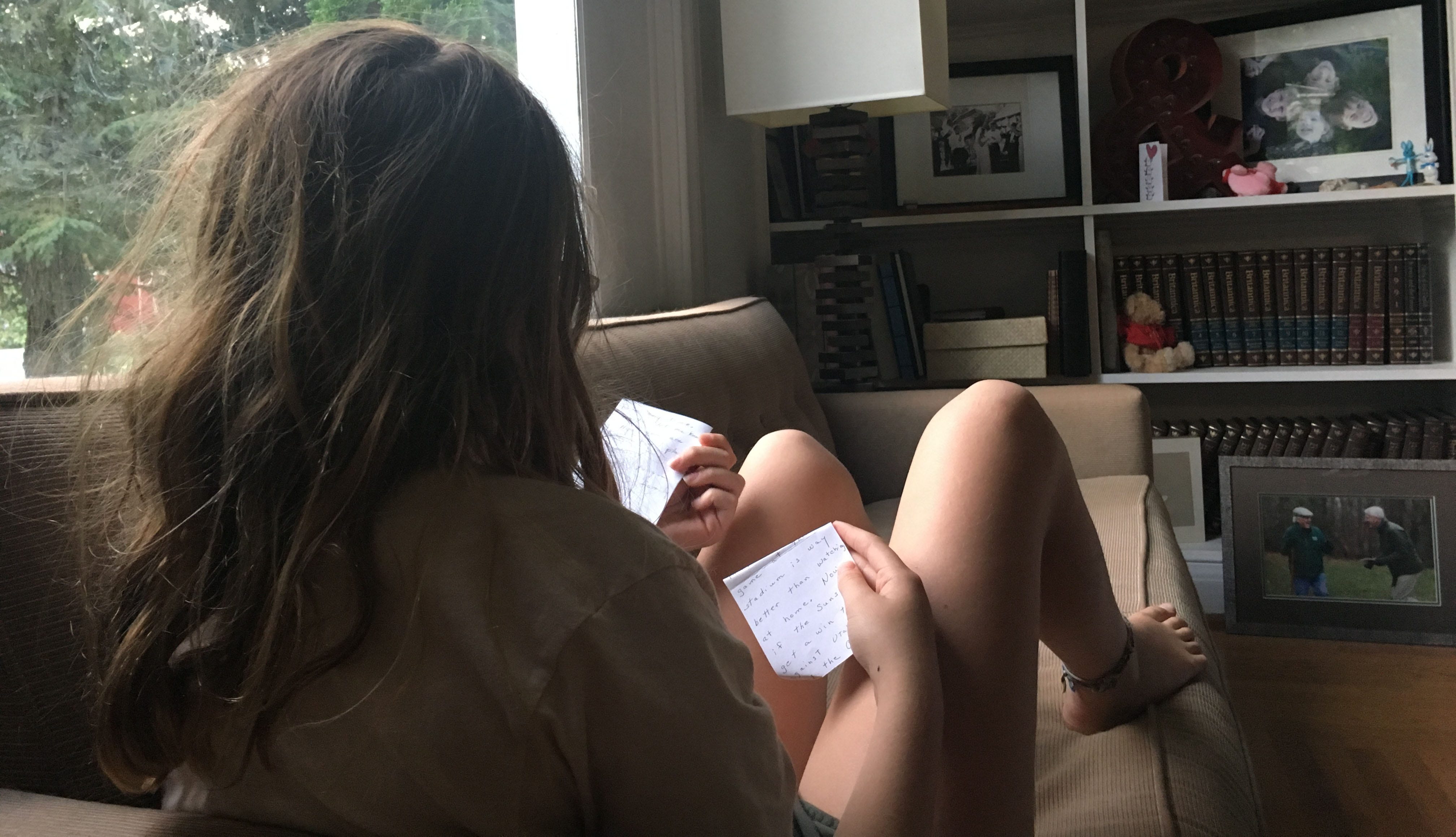
For a while, Henry, Luke and Lucy each received a note from my mom in the mail. Later on we moved, she had sent cards and stickers, silly presents from the dollar store like stretchy condom bunnies and colored beads, clutter that got caught in the vacuum cleaner, that I simultaneously loved and hated.
Theo checked for weeks for a last letter of the alphabet that never arrived.
I was angry at myself for non mailing all of the messages my kids had written her in the by weeks. But I didn't accept a stamp or was in a hurry. I wondered if those notes would take sustained her until her pain could lift, medicine and therapy could work, or the burden of caring for her husband, who would dice three months subsequently, would pass.
There are researchers who will say that putting the onus on survivors is grossly unfair, that we demand more coin to understand suicide, to acquire what works so we tin do better.
They will say to look at how mental wellness screenings from primary care doctors or more training for therapists could reduce suicides. There are people who will say that a prevention mensurate such equally a net or barrier could take saved my female parent and that such measures buy more time for people to change their state of listen. They're all good things to recollect nearly, worthy places to direct anger or free energy. Simply I spent near of my fourth dimension looking inwards.
Sometimes at that place were periods when all I could experience was her absence. I could expect downwards at my knees, which wrinkle and bend in the same style every bit hers. But it wasn't her. I wanted to go be with her.
The summer after she died was the most difficult. I was working and taking the kids places and making dinner most nights, but even when I smiled or laughed, I was empty. I pretended I was fine, posted happy photos of my children on Instagram, and thought if I told friends that I was OK often enough it would be truthful.
Once a calendar week, I ran 9 miles for the empty space, but all it did was give me time to think and wonder why. I would tick through the list of reasons why logically I should be happy. But something in my brain wouldn't let me get there.
I went to counseling and lied to my therapist, saying the things I thought she needed to hear. I couldn't wait her or anyone else in the middle and say I no longer wanted to alive, fifty-fifty if it was true. I was agape to say it out loud. She prescribed me antidepressants, which I reluctantly began to take.
Information technology'south a common feeling, this depression after losing someone to suicide, all the same it oftentimes feels impossible to share. It's raw and scary, and sometimes information technology feels selfish or indulgent. My mom wasn't a child; she was 66, an developed who made her own decision. And yet it consumed me.
Most of the fourth dimension, every bit in the obituary that celebrated my mom's life, I neglected to mention how she died. I didn't want to tell people nearly my female parent. Her suicide was not a secret, but it was a wound, and talking about it allowed people dangerously close to the darkest parts of myself. I didn't want to tell people that I had decided I didn't belong here anymore, that I had removed my seat belt while driving and sped toward a concrete wall underpass, jumped up to run into if the pipes in our basement were strong enough to hold me or that I had fallen asleep hoping I wouldn't wake up. I didn't want to tell anyone that I had written notes telling my family farewell.
Expiry seemed the only answer. One afternoon in the summer after she died, I took off work and bought a one-fashion, aforementioned-day plane ticket to Phoenix. I wanted to be with her in the coulee.
Perhaps we all are ane step from the ledge. I couldn't empathize it until I could.
It scared me.
Death seemed the only answer. 1 afternoon in the summertime subsequently she died, I took off work and bought a one-manner, same-day plane ticket to Phoenix. I wanted to be with her in the canyon.
I was crying. I told the kids I but needed to leave, to get out of the house for a flake. I was sure they would exist ameliorate off without me. Theo handed me a note, I slid it in my pocketbook without looking at it. I collection away.
I got well-nigh to the airport, and I pulled over into a parking lot. I was crying, and even though I wanted to die, I knew I couldn't drive, I couldn't go habitation, I couldn't be.
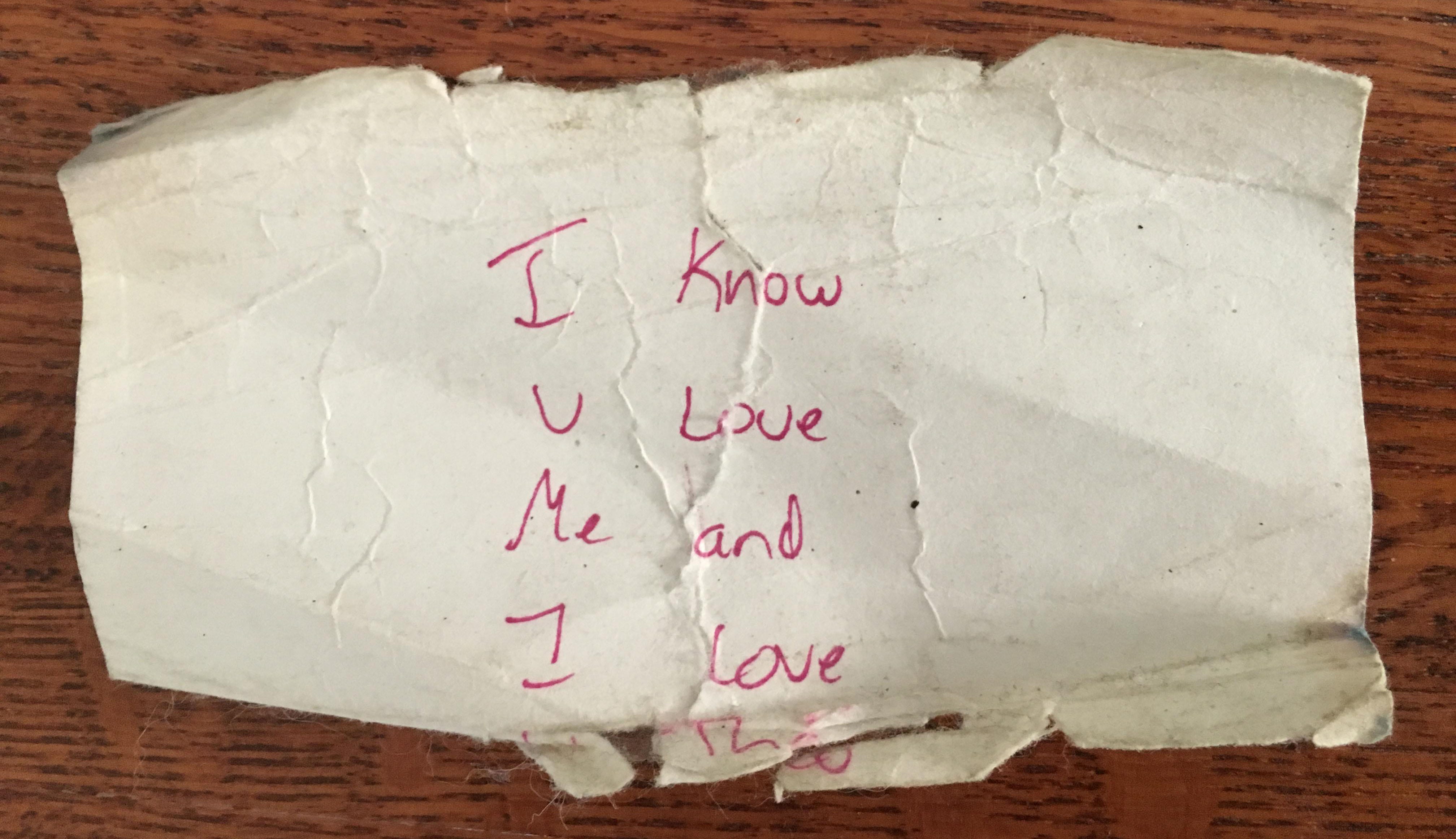
I read Theo's note, handwritten in a sparse magenta Sharpie on a iii-past-5 index carte du jour: "I know U love me and I honey U Theo."
I could non practice this. I saw my mom in Lucy, in her profile, in her eyes, the way she stood.
I went home.
Truth
I have learned, as do many survivors of a family unit member'due south suicide, that I am now at gamble. I have that now and baby-sit against information technology. It'south a place of caution and checklists. A place where I know to not stay alone in my head besides often and to say "yes" to walking the canis familiaris with my best friend.
Years of therapy, antidepressants and luck have led me here. At that place was no aha moment with my psychologist, no time when everything suddenly felt clear, no moment when my guilt disappeared. Instead there was more a wearisome monotony of months of sessions talking through my worries and what ifs, and the reasons I shouldn't accept them, until they slowly prodigal. I carried Theo's note in my wallet and later put it on my dresser to run into each morn. In the worst times, I had friends who texted but to bank check in and a husband who knew to send a kid with me on errands and so I wouldn't be alone. And with medicine, I at present had the sense to listen.
LEARNING TO COPE: Self-intendance tips in suicide survivors' own words
It took four years to tell Lucy the truth. I picked her up from her friend's firm on my fashion home from piece of work. It is a distance of 26 houses and ii left turns.
She looked at me, this fourth dimension as a 10-year-old, so much more grown up, not suspicious, non quite serious, just honest.
"Tell me actually," she said, "How did Grandma dice?"
When I told her, Lucy looked sorry and angry together. She got out of the car, dashed up the stairs to her room and slammed the door.
I knocked.
"Go abroad," she said. "You're a liar."
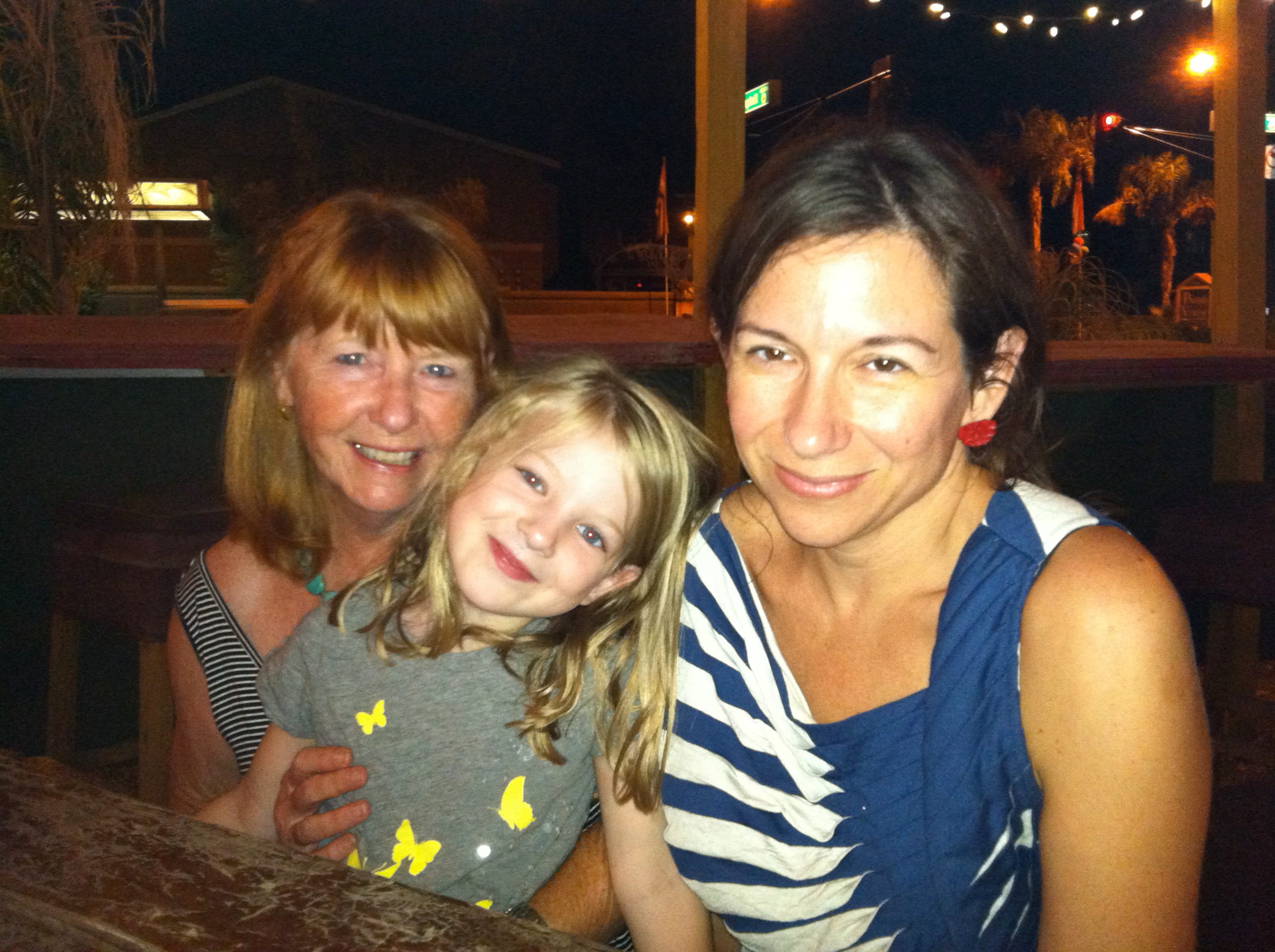
I wanted to say then many things: How much her grandma loved her, how my mom adored Lucy – her first granddaughter later on vi boys. How my mom used to make Lucy a special doll block each altogether. How much I missed her and how much it injure me. How I squinted and tried to figure out how many of those times that my mom stopped by our house with a beautiful smile and a hug when she wasn't happy, that she must have been hiding it and I missed information technology.
But when she came out, mayhap twenty minutes later, she only needed a hug.
"I don't desire you to do this," she said. She didn't look up at me.
"What? Do what?"
"Hope me. Merely hope you won't practice this?"
"What do you lot mean, Lucy? Simply tell me."
"What Grandma did." she said. "Please don't do it."
I've decided that I demand to live, not only for me, but my for children. I know what information technology felt like to be left behind.
The peachy unknown
At that place remained a yawning uncertainty. And questions, then many of them, about my mom.
My mom first saw the coulee when she was an adult, a visit with her sister shortly after she and my dad divorced. Afterward she hiked rim to rim with her sister – 23.5 miles from the North Rim of the canyon and back up the south, a hike that is revered in Arizona, a point of pride – the equivalent of a 26.2 oval sticker on the back of your car. She hiked the concluding time with her husband, taking the easiest trail as his knees started to give out.
The year my mom took her life, 12 others died at the coulee, as well – falls, heart attacks and suicides, more often than not. Enough people dice at our 58 national parks that the U.S. Forest Service has created a special team to deal with death. They are in that location to investigate and understand, to observe the adjacent of kin, to provide information and some context where there might not be whatever, and sometimes simply to stand quietly adjacent to you.
Ranger Shannon Miller agreed to see with me at the canyon four years to the day after my mom jumped.
Volition you be alone? She'd asked me.
No.
Good.
Nearing four years after she killed herself, a friend and I collection to the canyon from Phoenix at i,000 feet higher up body of water level, as a storm moved in and the heaven darkened. Information technology's just over a 3-hour bulldoze, a straight shot north on I-17 through the Sonoran Desert and so the Coconino and Kaibab National Forests. My mom would have made this drive in the middle of the dark or just before dawn. As we gained altitude, the saguaros gave way to scrubby bushes and later to ponderosa pine trees at 6,900 feet. Mule deer and elk dotted the roadside. By the time we reached Flagstaff, about ninety minutes from the canyon in northern Arizona, it was snowing and the temperature had dropped more than 55 degrees.
It is a long fourth dimension, Mom, to change your mind.
Shannon and I agreed to meet at Brilliant Angel Social club, where y'all can choice up a allow to army camp at the canyon's flooring, reserve a mule to behave y'all downward the trail, and end in the gift shop to buy an "I hiked the coulee" T-shirt, a toddler-sized ranger replica uniform, and a dream catcher fabricated by Native Americans for $26 or one not for $1.99.
In a row of books, the tales of the Harvey Girls and hiking trails, rafting and geology, I plant something: "Over the Edge: Death in the Yard Canyon, Gripping accounts of all known fatal mishaps in the most famous of the Globe's Seven Natural Wonders." Information technology boasted: "Newly Expanded 10th anniversary edition." A placard reads: "Souvenir Thought!"
I picked it up, glancing around to meet if anyone was watching. There was the story of John Wesley Powell, the first to explore the river cut through the canyon, and the TWA and United airplanes that collided over the rim in the 1950s and led to the creation of the Federal Aviation Administration.
I flipped through, and on page 470, I plant her.
My mom.
I put it down.
Shannon met me in front of the lodge, and I followed her truck to the spot where they found my mother.
"Gear up?" she asked me. She had that simply-correct mix of ranger and detective, and her smile felt like a hug.
Nosotros walked down a concrete path along the canyon, juniper trees on the left, a ledge and waist-loftier metallic pipage handrail on the right. I could see a short argue and jagged limestone that formed an overlook. When nosotros neared the spot, Shannon pulled yellowish caution record from her purse and cordoned off the trail.
"You might want some repose," she said.
I looked around, worried how this intrusion could ruin someone's view on their only trip to the canyon. She reminded me that there are many places to see the canyon and for at present, this was my spot.
I looked around, worried how this intrusion could ruin someone's view on their merely trip to the coulee. She reminded me that there are many places to encounter the coulee and for now, this was my spot.
"It's better this way," she said.
This spot along the 277 miles of coulee is known for one of the best views from the Due south Rim. The limestone here on the Kaibab layer is 270 meg years old. It's the youngest layer of the coulee, an area that in one case was covered with warm, shallow body of water. Its name is Paiute Indian and means "Mountain lying downwards," and somehow I like that image. Information technology makes no sense and yet is perfect.
The stone at the bottom – the vishnu schist – is ii billion years old, half as sometime equally the earth. Shannon talked volcanoes and rivers, snowfall and dry wind, tectonic plates and tributaries widening the canyon, about how native people roamed this expanse for thousands of years.
Up until 1858, when John Newberry was the offset scientist to attain the coulee flooring, the area was called the Keen Unknown. And even with as much as we know, there is nonetheless some contend as to how the coulee formed and the Colorado River'due south relatively new role in it.
Holding onto the rail, I peered over, looking downwards, further now, to a 2d ledge nigh 100 anxiety below. There were pine trees and a pinon, scrubby chocolate-brown world and openness. It looked like a shelf.
"There?"
"Yes, there," Shannon said.
"Information technology looks different," I said. Just 100 anxiety down, it already was a unlike terrain with different dirt and plants.
It'south the Coconino layer, Shannon explained, a layer that formed 275 million years ago. The lite sandstone forms a broad cliff. The lines you run across in this layer, the cross-bedding that run through it, reveal the story of an area that used to be covered with dunes, the wind blowing them into shapes, over and over again. Information technology appears there are waves within the rocks.
I got lost in the geology for a moment, standing in a place that held rocks 2 billion years old, and my brain placed the 2 and six – no, nine – zeros to the right. That is not forever simply an amount of time I could non understand.
I focused on the facts. The copse and rocks, how the Colorado river snaked below almost exactly 1 mile down into the earth, the sound of a raven and the low-cal rain that was slowly growing heavier and turning to snow.
My mom roughshod 5 million years.
"It'due south common cold."
That's all I could say.
Trying to understand
Jean Drevecky collection the Paul Revere shuttle charabanc that fourth Thursday morning of April, 2012. She would later tell the rangers that during her first round that morning she picked upwards a adult female near Bright Angel Gild who seemed at-home. That woman was my female parent. Jean remembered the woman sat alone, quiet, her hands in her pockets "like she was cold." The woman got off the bus five minutes later. Phone records evidence that my mom called her married man several times that morning. He remembered only the i that came at 6:56. It lasted four minutes. She was crying.
She told him, "This is it. I am finished I cannot proceed."
Her married man told rangers he tried talking to her about all of the good things in life. The ranger report doesn't detail what he meant by that, but they had scuba-dived the Great Barrier Reef and taken a hot air airship to a higher place Albuquerque, New Mexico. He plant the adventurer in my female parent, but he broke her, likewise. He broke us.
She did not say adieu.
"Your mom must know this place pretty well," Shannon said, noting that of all the miles of canyons here, my mom knew the place to jump where she wouldn't hurt anyone else and would be piece of cake to be found.
I was quiet for a moment, for once non feeling the need to fill up the space.
I nodded.
"Yes."
I looked down the trail, to the 27 switchbacks I counted until they grew tiny and disappeared into the coulee.
I'd been here before, I realized. With her.
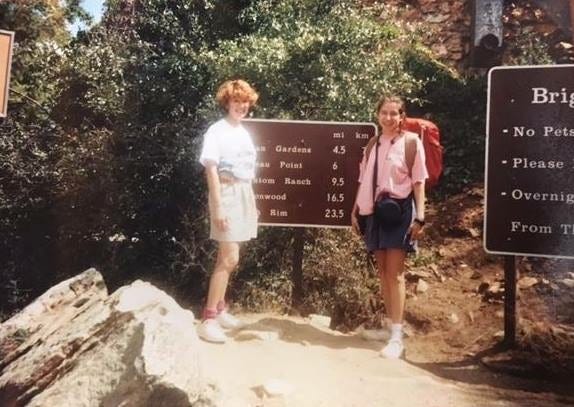
It was the summer afterward my freshman yr of higher, from an overlook – this one.
My mom took just one day off from piece of work, and we drove to the canyon on a Friday morning, sharing a double-bed in a hotel overlooking the Southward Rim. The next morning we woke earlier the sunday to hike the South Kaibab Trail, vii.1 steep miles down.
"Better down than up," she said in the happy singsong vocalization she used when whatsoever of u.s. faced something difficult and that I now sometimes hear in my own voice. I endeavor to remember the details, but only certain things stick out. Are the memories real or but built from photos? I had brought a Walkman that held the Depeche Mode "Some Bang-up Advantage" cassette record. It was 1989, and I would not own a CD player for another 3 years.
We carried h2o and salami, string cheese and a peach. I still remember we didn't eat the peach, and the bumpy hike downwards turned the fruit to mush in my JanSport haversack.
Reaching the bottom, a severe driblet in pinnacle to ii,570 feet, the temperature hit 101 degrees. Nearly the Colorado River it was every bit boiling as a sauna.
That nighttime we sat in a circle under the stars and listened to a ranger share a story about a mystery on the Colorado River. I leaned into my mom, her hair smelling similar Ivory because she done information technology with a bar of lather, and fell asleep.
I have a photograph of u.s. at the top later hiking up Brilliant Angel Trail. She is smiling, her hair permed and curly. Mine is pulled up in a ponytail, probable with a scrunchie. It is difficult to tell if I am happy or only exhausted. Every movie from the the past gets studied from time to fourth dimension: Does she look happy? Was she happy? Information technology's but one moment from almost 30 years ago, and I don't have the answer.
How does someone get from happy to suicide? Was she truly happy or did we only miss the clues?
Had she been sick her whole life? Sometime afterward the funeral my sister and I discussed the day when we were kids that our mom set a burn in a bathroom garbage can. My mom put it out before it spread. Presently later, our grandmother and her grumpy miniature Schnauzer moved in with us.
And so the affair with suicide is this: Everyone has their own part of a story, just many won't share. No one has the reply, and sometimes the bits they have, they lock inside. Or they retrieve the mode they can, or want.
After my mom died, we each tried to understand what happened and what nosotros knew. My sister shared that at some point when I had been in eye schoolhouse, my mom collection to a parking lot after her night shift at a hospital with a handgun she had bought for self-defence force. She changed her heed.
My sis said that our grandmother told her that our mother was put in a infirmary at some signal before she got married, but when I asked my sis later about this she said she didn't remember and no longer wanted to talk about it. My mom's mother, brother and sister don't want to talk to me virtually my mom'south suicide.
So the thing with suicide is this: Everyone has their own part of a story, but many won't share. No i has the reply, and sometimes the bits they have they lock inside. Or they recollect the manner they tin can, or desire.
And stories change over the years – retentivity, maybe, or survival. There are parts to this story that we each have but won't share. So none of the states can see the contours and texture of this story, this woman, this life. We just accept our disappointments, our myths and our guilt.
For 4 years, I was certain that the final letter my mom wrote had a stamp with the painting of the Grand Canyon on it. So certain that I never even checked, so sure that I couldn't fifty-fifty look at it until one day I did, and the canyon looked shallow. Information technology actually was Cathedral Rock in Sedona, according to the U.Due south. Post Role. Even facts are our own, every bit are truths.
When I recently asked my dad about my mom, if he remembered her existence depressed or if at that place were signs, he said he doesn't retrieve any. "Why don't you lot allow things be, Laura?"
I told him that writing about it might help. Not me, but others.
His wife interrupted.
"You lot might not know this, just my brother killed himself," she said. "I blamed myself forever. He always chosen me earlier he left work to say, 'I beloved you, sister.' And i night he didn't."
Looking back, she said, that was unusual. "I could accept chosen him," she said, her vocalization disappearing, "I could have checked."
My sis and I love each other. She is ever polite, the one to simply grin when I say out loud what I am thinking. She also is the one who cleaned everything out of my mom'south firm, the one who claimed her ashes. She is the one who dropped off groceries weekly for our stepfather because she idea my mom would want that. She is the one who was called three months later when the newspapers were piled upward in front end of the house. Our stepfather was dead.
Things fell on her that weren't like shooting fish in a barrel, and there are stories she keeps to herself.
Piecing together what we had
My mom knew there was a ledge; she would be piece of cake to find. She knew there was no trail below; she wouldn't hurt anyone only herself. She had safety-pinned a tiny slice of newspaper onto her jacket with the name of her hubby and his phone number. I wonder if the ranger is telling these details to make me feel better. I have a notebook and a pen, and we speak without emotion. This is improve, I decide. I am a reporter learning the story. But I am as well her daughter, trying to find answers.
"We have people not as courteous equally your mom," she tells me.
The first phone call to the park that April morning came at seven:15: A woman was threatening suicide. My mom had called her hubby, telling him that this was it, she was ending it all. She told him she was at the canyon. He called the police, who alerted the National Park Service. Iii rangers quickly searched 12.ii miles forth the South Rim. By ten:45 a.m., as the atmospheric condition cleared, the rangers launched a search helicopter. Within xv minutes, they spotted her body.
Ii rangers hiked down Brilliant Angel Trail and cutting across the canyon where they walked another half-mile to attain my mother. They recorded the location.
The ranger zipped my mother's body into a bag, and that handbag within some other. Considering the winds were likewise strong, they couldn't fly her out that day, and so he secured the bag to a skinny pine for the dark. The temperature dropped to 28 degrees.
The adjacent morning the same ranger hiked back to her body and waited until the same helicopter hovered overhead and dropped a handbasket. By happenstance, my friend Megan had hiked to the lesser of the canyon that morning. She saw condors, rare to encounter at the canyon, swooping close to the rim.
Watching the birds, she almost didn't notice the helicopter. But hikers know what a helicopter means when a basket hangs beneath. People paused their hikes. Some crossed themselves and prayed, Megan said, or stood repose. She didn't know who was in the handbasket. The helicopter was the but sound.
There were so many signs. Information technology's easy to meet them at present.
I learned later that my mother had told my sis she was staying at my grandmother'southward house and told my grandmother she was staying at my sister'due south business firm. They both had been worried, checking on her daily. My mom told her sis that she wanted to "walk in front of a truck" and had told my sister she had been going to therapy, as she felt responsible for bringing her husband into my life.
Before that calendar week my mom had stopped to see her mother and given her one of her favorite turquoise necklaces that she fabricated, looping a tiny silvery heart into the squeeze. We would learn that she had as well recently moved her house into a trust for my sis and me and written her financial data and passwords in a green notebook. At the same fourth dimension, she wrote messages full of hope and sweetness to her grandchildren. She went to Mass and talked to her priest.
While researchers say most suicides are more impulsive, my mom's seemed to have left an obvious trail. She was feeling helpless, carrying blame, putting her diplomacy in order, giving away possessions. Merely it didn't look that way to whatsoever of us at the time.
Despite all of the research, there yet isn't a proven formula that can predict precisely who is going to kill themselves and who won't; which interventions piece of work for everyone, or piece of work for a while, and which don't; which words might save someone one twenty-four hour period only to have them sideslip abroad the side by side. Information technology doesn't make any sense why one person who demonstrates all the risk factors lives and another kills herself.
The only person who can explicate is gone.
So nosotros are left to guess, to piece together what we had. None of u.s.a. had all of the pieces. The wreckage of my stepfather'due south beliefs had left our family in a country of strain. We weren't sharing information or beingness honest with each other as we might have in smoother times, which made us normal.
Something the priest had told me stuck with me: "All families are difficult," he said. "Some families just know it, and others don't."
She parked her white Jeep Liberty in the parking lot almost Bright Angel Lodge. She wrote notes to her family unit in a tiny black and white limerick book with her proper noun handwritten on the front.
In one, she wrote, "Delight don't attempt to find arraign. … I take been sick for a very long time and didn't take intendance of me."
To me, she wrote: "I can never make things right & no affair what I say or do you will never believe me. Mayhap at present you can get on with living. You have and then much to alive for and your family needs you. I practice too. … Be kind to yourself. Love mom."
The arc of time
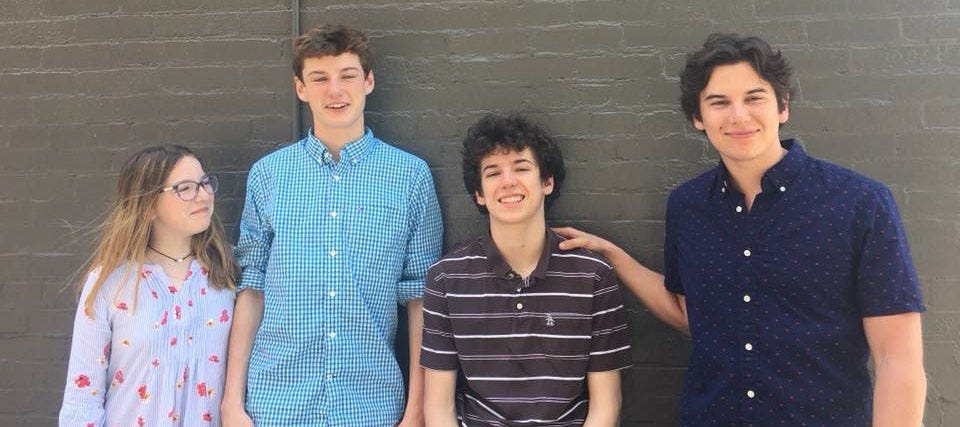
My kids take learned in their own ways to try to empathise how their grandmother concluded her life, also as how she lived it. Henry, my oldest who even as a teenager would drib everything he was doing when my mom would stop by, smiles when he talks most her. Now a higher junior, he withal has a wallet-sized card she made for him when nosotros moved, a photo of her yellow Lab on it and a handwritten note, "Always remember, Grandma loves you lot. Telephone call me whatsoever time."
Theo, who was just erstwhile plenty to understand how she died, is at present a loftier schoolhouse senior and the one who sometimes shares stories about her that even I don't know: how she made chocolate chip cookie bowls for water ice cream when he stayed the nighttime at her house, or read "The Hunger Games" along with him when he was footling, worried he might demand someone to ask questions.
Luke still doesn't talk much about her, but as he learned to drive this past summer, he teased me that I drive exactly similar my mom: irksome and deliberate, with the radio turned down, and I say the exact phrase she would say to me: "Drive carefully. You have precious cargo."
Lucy talks near her often with a deep sense of closeness or connection that can surprise me at present that my mom has been gone longer than she was hither for Lucy. When I opened Lucy's locket, it had a photo of herself in information technology, which made me express joy. Until I saw that the photo on the other side was my mother. She e'er wanted them to be adjacent to each other.
• • • • • •
There are days in the years since my mom killed herself that it has felt equally if the coulee was everywhere: An OmniMax theater, a school assignment on national parks, holiday photos on Facebook and on the nightly news. Suicide, it seems, also is everywhere: A friend's son took his ain life, as did the mother of a former co-worker. A friend shot and killed himself. Some other friend told me his mother had killed herself when he was just 12, and for 40 years he has never told anyone but his wife. One celebrity after another dies by suicide, their faces dotting the news.
Column: Media coverage of suicide must go beyond celebrities
I have read and re-read the concluding text that my mom sent that morning, the one that said her eight grandchildren had been the joy of her life. "I will miss yous and seeing yous grow to be cute adults. I'm so sorry I disappointed all of you lot, in my heart I know this is non right, but it'southward all I can exercise. Pray for my soul."
I have spread her ashes in many places she loved, from the highest hills in Corsica to this very spot at the Thousand Coulee.
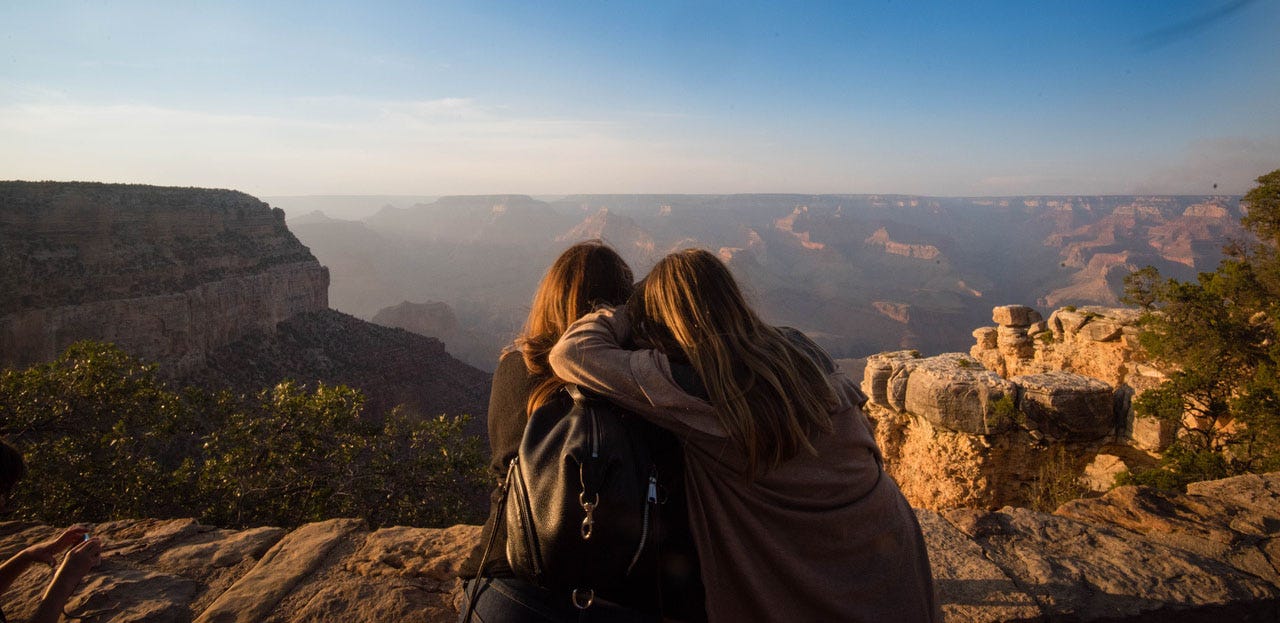
And on a late summer dark this twelvemonth, afterward I walked the 197 steps from the shuttle bus end to the point at which my mother jumped, later on I learned every detail downwards to the pinnacle of the railing, I returned to the canyon with my daughter.
On a night without moonlight, you lot can just run across a coating of stars, more stars than sky it seems. At night the canyon is just a deep, night pigsty, and in some ways information technology feels more impressive than in daylight, the emptiness of it all.
Only as the canyon is and so unknowable that geologists and scientists can written report it, merely volition never know exactly how it began, the same is true nearly my mom. I'k figuring out how to exist OK with that.
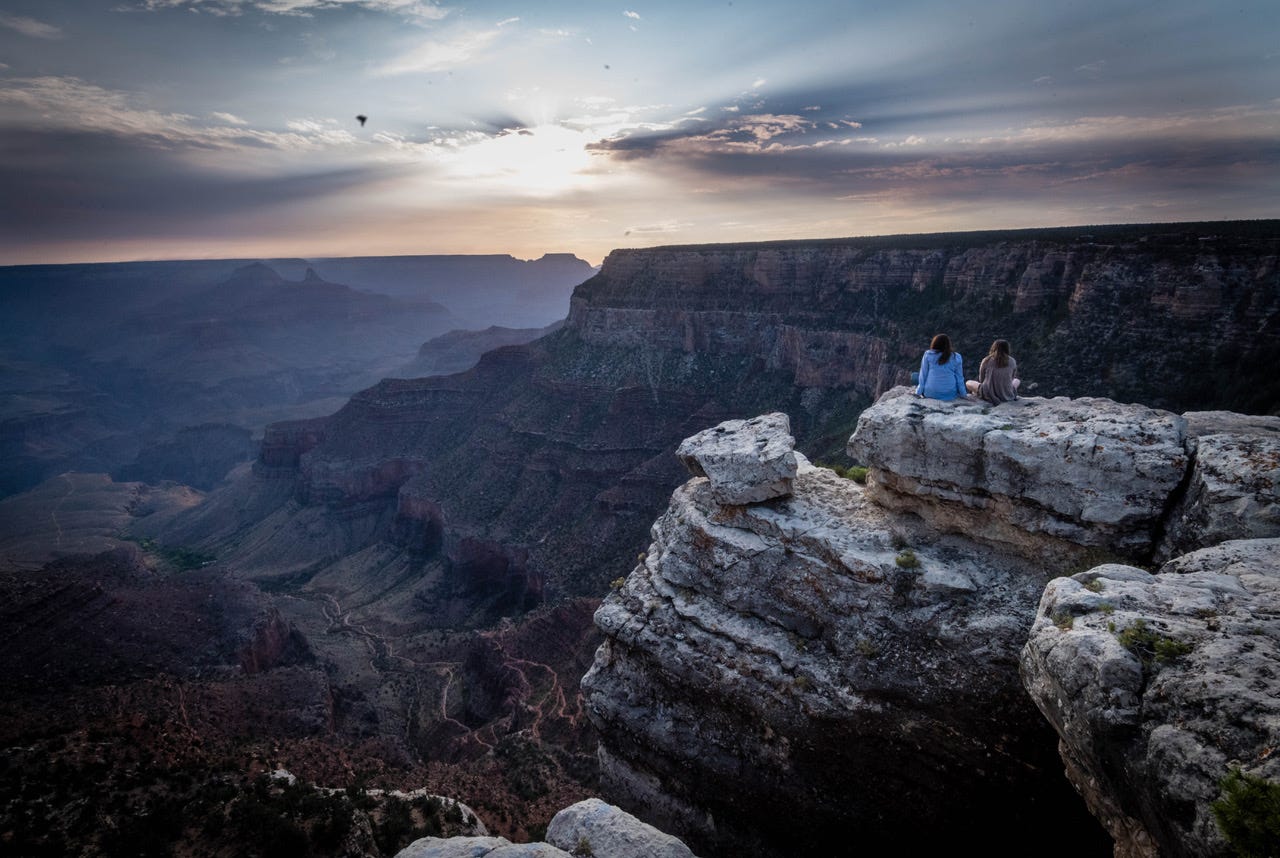
I think of her that morn, walking to the ledge. Did she encounter the blush of the sky as the sun rose, casting the n wall of the canyon in gold and leaving the south in blue? Did she hear the hooves of the mules every bit they carried visitors to the lesser? Did she climb over the argue or become around it? Did she run across how the juniper attaches to the rock, because that's in the nature of all living things – to cling to life and to the earth equally if everything depended on information technology? Did she walk out onto that high limestone boulder? Did she sit down for a while and take it all in? Did she weep?
The truth is that the timeline says she didn't brand time for that. She was here, and she was gone.
And so I bring my daughter to this place, not to meet where my mom ended her life, not because I remember I'll observe an answer, but to prove her the beauty and the quiet, the arc of fourth dimension, the fashion something as immutable as rock looks completely unlike in the shifting light, to witness the grand pattern of the earth, to feel the forces older and stronger than the earth itself, and to take the vastness of the things we cannot know.
Laura Trujillo and her married man and four children live in Ohio. Laura is a former reporter and editor who worked in the Southwest and Pacific Northwest. Now she works for a financial services visitor.
Editor'south note: This story was written from a report from the U.S. Park Service, interviews with family members and experts, notes and the author's retention. Dialogue in some parts of the story, such as with the ranger, was recorded in notes. Other dialogue has been recreated based on interviews and the author's memory. The stepsister of the author, when contacted most allegations of abuse about her father said, "That's not the man I knew."
Source: https://www.usatoday.com/in-depth/news/investigations/surviving-suicide/2018/11/28/life-after-suicide-my-mom-killed-herself-grand-canyon-live/1527757002/
0 Response to "Why Does She Want to See the Bag Boy Again"
Post a Comment